

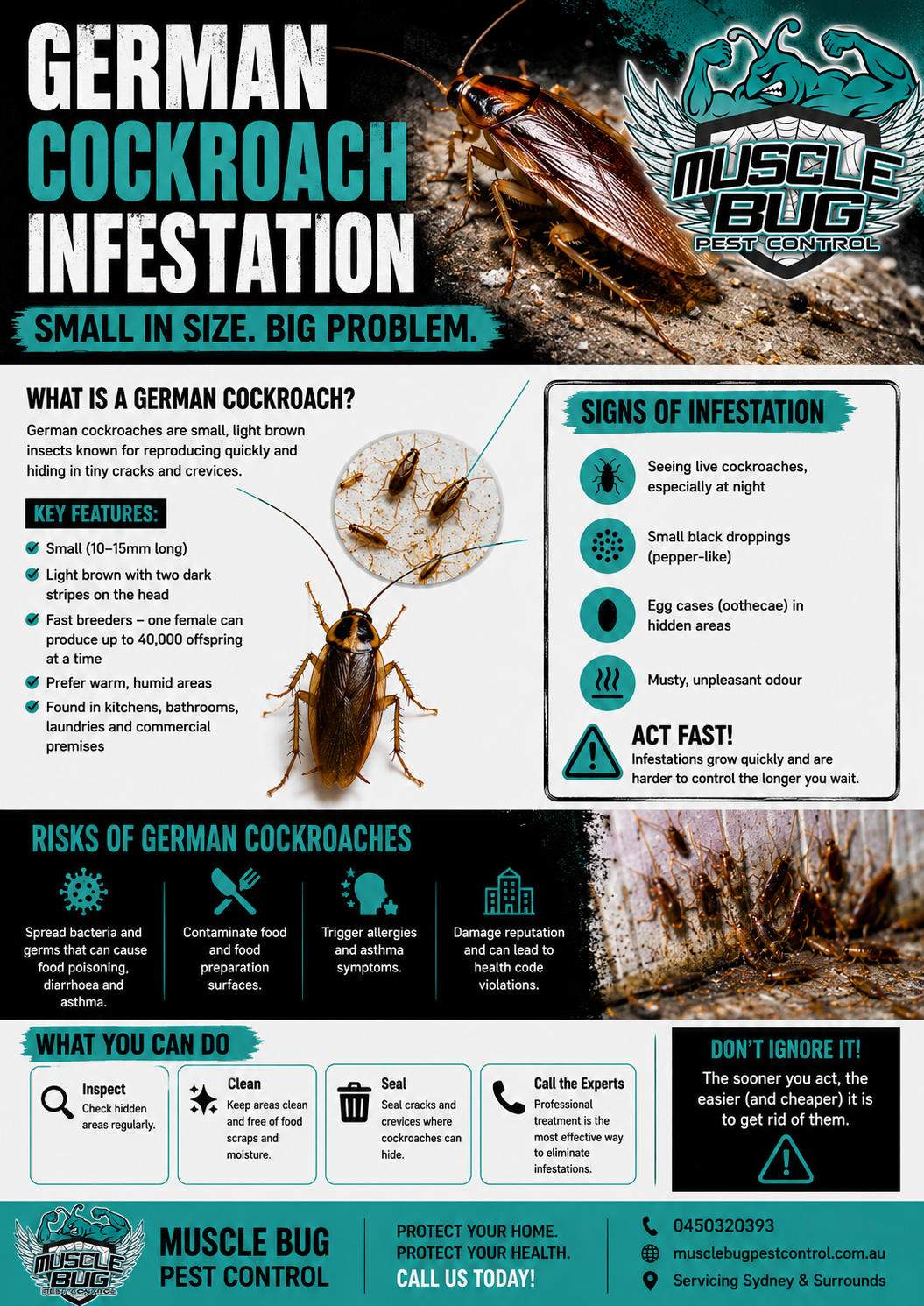
Small Pest, Big Problem: How German Cockroaches Invade and Multiply
Introduction
You spot one tiny cockroach scurrying across the kitchen bench at midnight. You squish it, think “that was weird,” and go back to bed.
A few weeks later, you’re seeing them everywhere.
This is the German cockroach (Blattella germanica) in action – the most widespread and notoriously difficult pest cockroach in the world. Understanding how they arrive and how quickly they multiply is the first step to stopping them.
How Do They Get In?
German cockroaches don’t just wander in from the garden. They are hitchhikers.
The main culprits:
· Packages and deliveries: Cardboard boxes, grocery bags, and online deliveries are a classic entry point. They hide in corrugated cardboard and ride straight into your kitchen.
· Second-hand items: Furniture, appliances, and luggage can carry hidden stowaways.
· Cracks and crevices: They can squeeze through gaps as small as 0.5 millimetres – less than the width of a credit card.
· Shared walls: In apartments and townhouses, they spread through pipes, electrical conduits, and wall voids from neighbouring units.
· Food and supplies: Commercial kitchens and restaurants often introduce them via incoming stock and packaging.
Unlike some cockroaches that live outdoors, German cockroaches have no natural habitat – they exist solely in human buildings. They need us to survive, and we keep accidentally giving them a free ride.
Why Do They Explode in Numbers?
Once they’re in, they don’t mess around. German cockroaches have the fastest reproduction rate of any household cockroach.
Here’s how quickly it adds up:
· One mating is all it takes: A female only needs to mate once to produce eggs for life.
· Each egg case holds 30–40 eggs.
· She produces 4–8 egg cases in her lifetime – that’s up to 320 offspring from a single female.
· She carries the egg case until just before hatching – this protects the eggs from predators and pesticides.
· Nymphs mature in 6–8 weeks and are ready to breed immediately.
· A female produces a new egg case every 7–10 days.
The numbers are staggering:
· One female and her offspring could produce 300,000 roaches in a year under optimal conditions.
· Other estimates put it at 575,000 offspring in a year.
· Either way, a small infestation becomes a large one very, very quickly.
Within a healthy population, you’ll typically find four nymphs for every adult – meaning most of the colony is young, growing, and reproducing.
The Hidden Cost
Beyond the sheer numbers, German cockroaches are a genuine health risk.
· They carry over 40 types of bacteria and pathogens, including Salmonella and E. coli.
· They trigger asthma and allergies, particularly in children.
· They produce a musty odour that becomes noticeable in heavy infestations.
In apartment buildings, they’re considered a major cause of childhood asthma.
What You Can Do
Prevention:
· Inspect deliveries: Open boxes outside and check for unwanted passengers before bringing them indoors.
· Seal entry points: Caulk cracks around sinks, doors, and pipe penetrations.
· Reduce moisture: Fix leaks and use exhaust fans in kitchens and bathrooms.
· Store food properly: Keep dry goods in airtight containers and clean up grease and crumbs.
If you spot one:
· Don’t assume it’s alone. A single sighting often means an active breeding site nearby.
· Look for tiny black droppings (like pepper), shed skins, and egg cases.
· Call a professional. DIY sprays often make the problem worse by scattering the colony and encouraging resistance
Protect Your Home
German cockroaches are relentless, but they’re not unstoppable. Early detection and professional treatment are the keys to keeping them out.
At Muscle Bug Pest Management, we specialise in targeted German cockroach elimination using baiting, monitoring, and proven IPM strategies. We don’t just treat what you see – we find the harbourages and break the breeding cycle.
Contact us today for an inspection.
📞 0450 320 393
📧 info@musclebugpestcontrol.com.au
🌐 www.musclebugpestcontrol.com.au